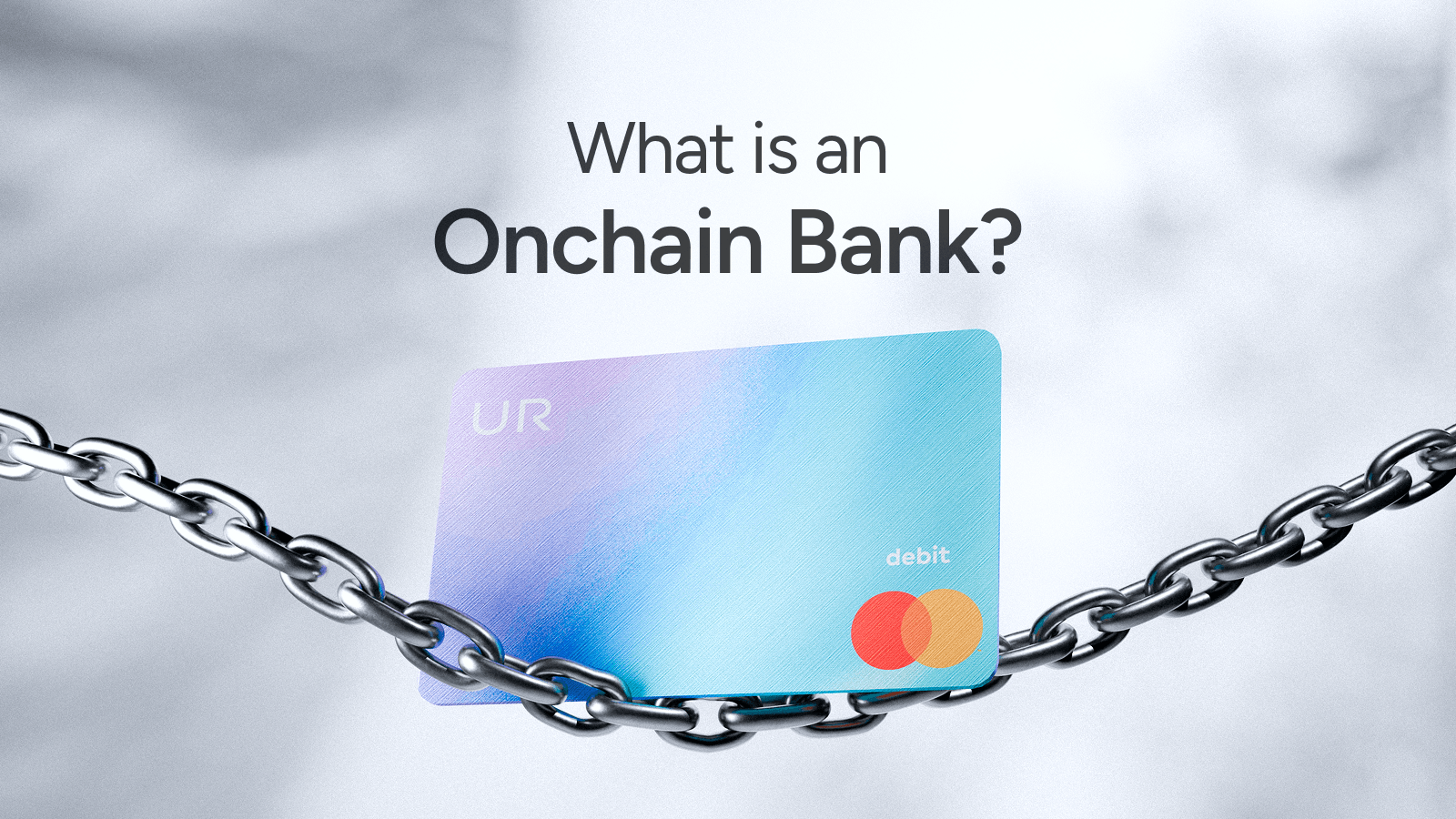
Sluggish digital banking apps, snaking branch queues and wire transfers that take days to process. This is the reality of today’s banking experience; it’s slow and complex. Fortunately, change is coming with onchain banks on the rise. As a user, you won’t have to worry about cross-border fees and bank operation hours as your wallet now becomes your bank account and personal vault.
Unlike traditional banks locked into business hours and bureaucratic processes, onchain banking lives entirely on the blockchain. You can convert, spend, earn yield, and transfer money instantly across borders without asking for anyone's permission. No gatekeepers. No delays. No hidden fees.
Curious what the fuss is all about? Let's break down how onchain banking works and how UR is simultaneously bringing freedom and efficiency to every transaction and business.
What is an Onchain Bank?
An onchain bank is a financial institution that runs entirely on blockchain technology and uses it as its core infrastructure instead of traditional centralized databases. This means all your transactions, account balances, and financial activities are recorded and executed on a transparent, programmable ledger. In doing so, you gain access to banking services like savings accounts, loans, and other financial products supercharged with the advantages of blockchain infrastructure.
Onchain Banks vs. Traditional Banks
Compared to traditional banks, onchain bank platforms are built using decentralized ledgers, which means that there is no central authority controlling the transactions. Instead of relying on such intermediaries, multiple distributed nodes validate and record transactions, ensuring transparency and reducing the risk of fraud. These platforms rely heavily on smart contracts that automate typical business processes like loan approvals and payments.
The use of tokens also allows businesses to manage and transfer assets in a more efficient and secure manner given their lack of reliance on traditional intermediaries and third-party clearing houses. Overall, this provides a more seamless experience across borders and industries.
How Does Onchain Banking Work?
Unlike traditional digital banking or fintech apps that just slap a nice interface on outdated systems, an onchain bank rebuilds the entire financial ecosystem from the ground up. You control your assets through an on-chain bank account that connects directly to the global financial system through blockchain rails.
In a nutshell, your bank deposits are tokenized, meaning they exist as digital assets on the blockchain. This unlocks faster transfers, lower fees, and greater transparency.
The key innovation here is that financial services are becoming programmable. Smart contracts, which are self-executing and trustless digital contracts with the terms of the agreement written directly into code on a blockchain, automatically execute transactions, manage risk, and enforce compliance without needing anyone to approve them manually.
Smart contracts essentially handle the work that bank employees and systems normally do. Instead of trust in third-party institutions, it's trust through transparent code that is immutable and permissionless, creating a financial system governed by logic rather than authority.
The basic flow works like this:
- You create an onchain identity that proves who you are without oversharing your personal data
- Your account lives on the blockchain as a digital wallet
- Smart contracts automatically execute transactions based on preset rules between the user and the on-chain bank
- Everything gets recorded permanently on the blockchain
Your funds with an on-chain bank can exist in different forms. You might hold stablecoins that maintain a steady value like traditional fiat money. Or you could diversify your assets by choosing to hold commodities and shares on the blockchain in the form of tokenized stocks and gold.
What Makes An Onchain Bank Work
Key components that do the heavy lifting for an onchain bank:
- Blockchain infrastructure validates every transaction through network consensus
- DeFi protocols enable lending, borrowing, and trading without middlemen
- Fiat on-ramps let you swiftly convert traditional money into digital assets
- Payment rails move money across borders faster than wire transfers
When you make a payment, the blockchain verifies your identity and checks that you have enough funds. Smart contracts then execute the transfer instantly, thereby expediting the process since no clearing houses or multiple banks need to process it.
For businesses integrating onchain banking, you control the entire financial stack. This vertical integration includes setting your own fees for incoming and outgoing payments, offering crypto and fiat services through one system and offering real International Bank Account Number (IBANs) connected to blockchain accounts that work globally.
Benefits of Onchain Banking
Cost and Speed (Operational Efficiency)
Businesses prefer on-chain banking because it removes the middlemen, significantly lowering operating costs. Without multiple intermediaries processing transactions, users effectively pay lower fees for everything from transfers to currency exchanges.
Speed and accessibility are defining features of this model. Cross-border payments settle in minutes rather than days, and funds are accessible 24/7, avoiding the delays of traditional banking hours or clearing houses.
The end result of this operational overhaul is perks like instant settlement, better exchange rates and transparent fees.
Financial Inclusion and Business Growth
Onchain banking is a powerful engine for financial inclusion, lowering barriers for the unbanked. Users can open accounts without heavy paperwork or minimum balances. Furthermore, the technology enables global access, as no physical branches are required. You can essentially access accounts from anywhere.
For businesses, this technology offers greater control and efficiency. Thanks to the modularity of onchain banking apps, companies can build their own financial infrastructure to offer customers specific asks to meet their needs. Neobanks thus use this model to compete with big banks by keeping costs competitive and relatively free from bureaucratic red tape.
Beyond these operational efficiencies, the onchain economy is proving to be a strategic asset in a changing world. Trends like de-dollarization, the onshoring of energy and compute infrastructure, and the rethinking of global trade flows align with the shift towards on-chain infrastructure. By decoupling from traditional banking rails, this infrastructure offers a neutral foundation for the next era of global commerce that’s to be enjoyed by on-chain banking users.
Trust and Security (Systemic Advantage)
Transparency is automatic. Since all activity is verifiable on the public ledger, this reduces fraud and creates accountability that traditional systems tend to lack.
Immutable execution within the blockchain guarantees fairness. Beyond just seeing the data, onchain transactions ensure that nothing can be retroactively altered. Once a transaction is confirmed, it is finalized and cannot be reversed or censored by a central authority. This immutability protects users from the "rewriting of history" often seen in centralized ledgers during crises, where trades might be canceled or balances adjusted to protect the institution rather than the user.
Programmability then enforces the "Code is Law" standard. Smart contracts automate trust by executing transactions exactly as programmed, without the need for an intermediary to "approve" the action. If the conditions of a trade or loan are met, the code executes instantly and impartially. This removes counterparty risk where the other party may refuse to pay because the assets are held in escrow by the code itself, not by a human agent who could be swayed, coerced, or negligent.
Finally, onchain systems give users maximum choice and control. Non-custodial wallets allow users to control their assets directly, without relying on a third party to hold the assets. Users have the option of using either custodial (managed) or non-custodial (self-managed) wallets when deciding how they interact with and manage their funds.
Together, these features form a trustless security model where users are protected not by institutional promises, but by verifiable code and decentralized infrastructure - making blockchain systems inherently more secure than traditional financial networks. This is doubly so when considering that these onchain banks may have additional regulatory operational licenses, allowing them to bridge the gap between compliant fiat banking and permissionless blockchain protocols by ensuring that there is a legally recognized entity responsible for safeguarding user funds against operational negligence.
Risks of Onchain Banking
Like all finance-related aspects, there are certainly risks involved when it comes to embracing onchain banking. These can include the following:
- Operational complexities that include managing onchain transactions and spiking gas fees during peak periods.
- Fundamental security shifts as users take on private key custody and counterparty risk of the onchain banking infrastructure falling prey to hacks.
- Loss of traditional safety nets like FDIC insurance and backend transactional freezes in the case of fraud.
- Regulatory uncertainty due to ever-changing compliance laws and Anti-Money Laundering (AML) and Know Your Customer (KYC) standards being harder to implement onchain.
- Liquidity crunches and bank runs may occur as sharp market drawdowns cause users to simultaneously redeem tokenized deposits or unwind positions, forcing the institution to liquidate assets at depressed prices.
At a glance, these onchain banking risks may feel familiar. From complicated operations to liquidity crunches, these are common problems that plague traditional financial institutions too as they stem from the shared principles of leverage, credit and market psychology.
While the risks of this new frontier are real, they are the price of admission for a system that is arguably more transparent, more efficient, and more equitable than anything that has come before. As such, it’s no wonder many users have shifted to onchain banking to try their hand despite these temporary teething issues.
The Future of Decentralized Banking Systems
The unfortunate reality is that traditional banking and digital assets mix together as well as oil and water. Banks treat digital assets like a liability, slapping on extra fees, flagging transactions, or worse, closing your account altogether. Meanwhile, managing finances across multiple wallets and bank accounts is exhausting.
UR flips the script. It's a licensed financial platform that gives you a bank account run on blockchain Digital assets and fiat? They work together seamlessly. No artificial barriers. No sketchy workarounds. Just straightforward financial freedom.
What Makes UR Different
Most "digital asset banks" force you to choose: either custody your assets yourself or trust a centralized platform. With UR, you can access both full self-custody and bank-grade features, all without the traditional banking friction.
- Zero off-ramp fees converting digital assets to fiat
- Multicurrency support in USD, CHF, RMB, HKD, SGD, JPY, and EUR
- Near-instant digital asset-fiat swaps in two clicks
- Full self-custody meets banking integration so you own your assets while enjoying the financial services you’re used to in a secure and compliant way
- An all-in-one digital assets and fiat financial account that you can freely manage
UR built banking services directly on blockchain instead of bolting digital assets onto legacy systems. Your account doesn't need approval from a traditional bank because the blockchain is the infrastructure.
Stablecoin Utility
On most platforms, receiving stablecoins feels like a hassle. Not with UR. Thanks to native stablecoin support for the platform, you can receive and bridge USDC, USDT, or ETH directly with no intermediary steps even when you’re converting to fiat instantly. Your funds stay in one unified account instead of scattered across multiple wallets and banking logins.
Spend Anywhere
Got fiat converted and ready to use? Your Mastercard debit card works globally. Sending money to another UR user? Fee-free transfer, instantly settled.
The real perk is that you're spending money that actually belongs to you, without anyone telling you what you can or can't buy.
One Platform, No Juggling
The all-in-on experience is a game changer, especially when the on-ramp, off-ramp, account and spending happens on a single platform. No moving funds between services. No waiting for slow bank transfers. No hunting down your transaction history across five different apps. No third parties or your bank trying to verify your identity for every transaction. Everything happens in one place with transparent fees and fast processing times.
Wrapping Up
Rather than being a fun slogan, "Safer, Faster, Borderless Banking" is an accessible reality that’s happening faster than you think. All you need is an internet connection to access global financial markets as you gain financial autonomy in its purest form thanks to services of on-chain banks and platforms like UR that seamlessly bridge the gap between digital assets and traditional finance. By eliminating intermediaries and offering tools like instant digital asset-fiat swaps and multi-currency accounts, these services empower you to bypass the bureaucratic red tape and delays of legacy systems. Ultimately, this technology rebuilds the financial ecosystem from the ground up, ensuring that your wealth is managed with transparency, speed, and true ownership.
Heard about digital wallets and want to know how they differ from their smart money counterparts? Check out our in-depth guide that highlights the differences between wallets and smart money apps.
FAQ
How do on-chain banks handle transactions without employees?
These onchain banks utilize smart contracts, which are automated protocols that handle the work typically done by bank employees. These contracts automatically execute transactions, manage risk, and enforce compliance rules based on preset guidelines without needing human intervention.
Can I earn interest on my funds like with a traditional savings account?
Onchain banking allows users to earn yield on their assets. Since the infrastructure removes expensive intermediaries and increases efficiency, companies can often build financial infrastructure that offers customers more competitive interest rates and better wealth opportunities compared to traditional banks.
Can I use onchain banking for my business operations?
Yes. Onchain banking is not limited to individuals; it offers specific advantages for businesses. Companies can use the technology to control their entire financial stack, which includes setting their own fees for payments and offering real International Bank Account Numbers (IBANs) connected to blockchain accounts. Additionally, businesses often prefer this model because it removes middlemen, significantly lowering operating costs and allowing for cross-border payments that settle in minutes rather than days.
Will my transaction history be visible to everyone?
There is a balance between transparency and privacy. Because on-chain banks run on a public ledger, transactions are recorded permanently and can be verified by anyone. However, the system allows you to create an "onchain identity" that proves who you are without oversharing your personal data. While the ledger is transparent to prevent fraud and ensure accountability, your identity is not necessarily fully exposed in the same way it might be on a bank statement floating around an office.
Do I need to be a "tech whiz" to manage an on-chain bank account?
While the underlying technology is complex, the goal of on-chain banking is to strip away that complexity for the user. Platforms like UR are designed to feel like modern bank accounts, allowing you to convert, spend, and transfer money without needing to understand the coding behind it. Smart contracts handle the technical "heavy lifting" automatically, executing transactions based on preset rules so you don't have to manage them manually.
Why is DeFi important for onchain banking?
Decentralized Finance (DeFi) effectively allows on-chain banks to operate without the need for traditional financial institutions. By offering businesses services like lending, borrowing and trading directly on the blockchain, businesses can maintain control over their assets while directly accessing capital, earning interest, or hedging their positions through decentralized protocols. This eliminates the significant overhead and delays associated with traditional intermediaries, resulting in faster settlement times and lower transaction costs overall.