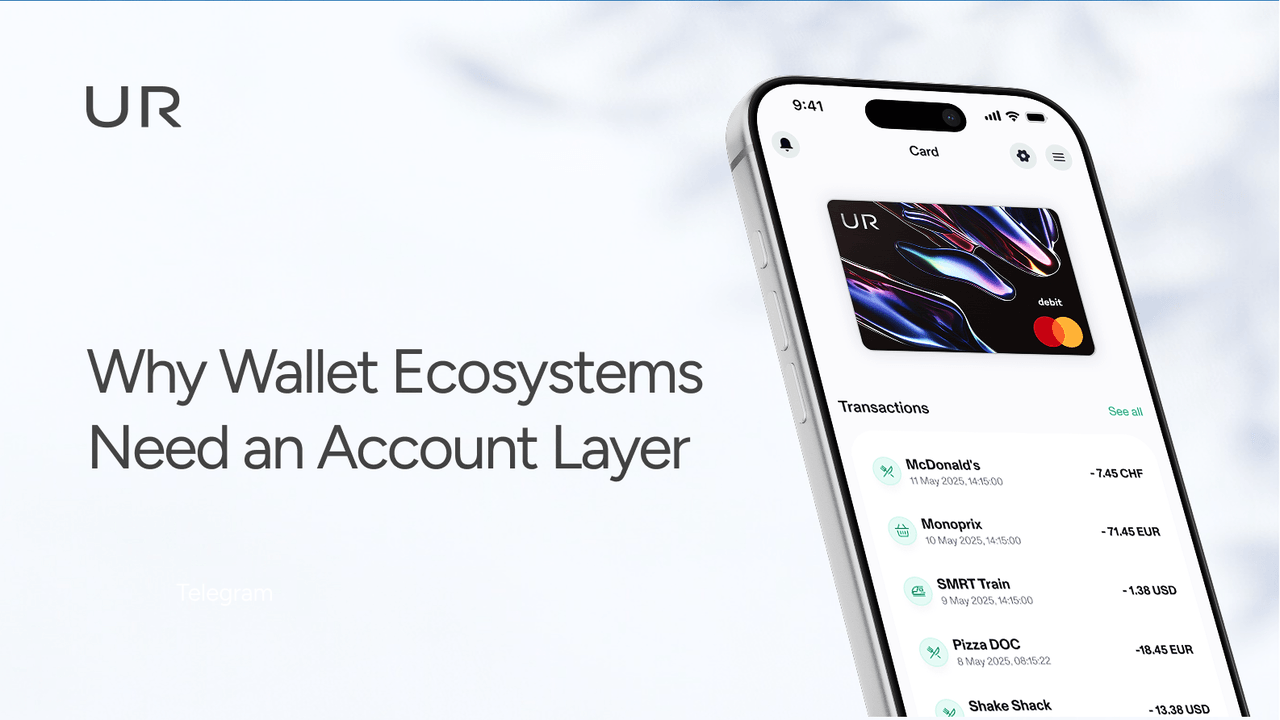
Why Wallet Ecosystems Need an Account Layer

An account layer turns an onchain wallet into a real financial account — personal IBAN, multicurrency balances, card spending and bank rails under one verified identity. What it is, who needs one, and whether to build or buy.

14 Jul, 2026educationFrancesca Tay
Read More
Why Wallet Ecosystems Need an Account Layer

An account layer turns an onchain wallet into a real financial account — personal IBAN, multicurrency balances, card spending and bank rails under one verified identity. What it is, who needs one, and whether to build or buy.

14 Jul, 2026educationFrancesca Tay
What Is the Open Economy?

The open economy is the financial system as it actually works today: value moves across two sets of rails — stablecoins and fiat — but those rails were built apart.

07 Jul, 2026educationUR Team
UR x Tempo: UR is a Licensed Account and Card Provider for the Tempo Ecosystem

07 Jul, 2026announcementsUR Team
Multicurrency Mastercard Issuance for the Wallets, Exchanges & Platforms

This article focuses on UR's card layer, what partners get from integrating it, how the underlying multicurrency spending works for their users, and why the architecture matters for the partners.

30 Jun, 2026productUR Team
Money 20/20 Amsterdam: Where Payments Is Actually Heading

Three themes kept surfacing across every conversation at Money 20/20 — partnerships over licensing, B2B2C durability, and the search for tokenization's first real use case.

11 Jun, 2026reviewsUR Team
What are Omnibus, Segregated & Nested Accounts?

Every fintech app, crypto exchange, and neobank you use sits on top of one of three account structures: omnibus, segregated, or nested. Here are the differences.

05 Jun, 2026educationUR Team
Security, Compliance, and Trust in UR's Account Layer

Find out who carries KYC and AML liability, how deposits are protected, and what compliance is actually built into UR's account layer infrastructure.

21 May, 2026educationUR Team
Wallets vs. the Account Layer: What’s the Difference, and Why It Matters

A wallet holds tokens. An account layer holds a financial life. The difference is structural — and it’s why the next generation of wallets are integrating UR's composable financial stack.

18 May, 2026educationUR Team
UR's Account Layer: Composable Financial Infrastructure

UR is the account layer for the composable era. Every UR primitive, including identity, multicurrency tokenized deposits, fiat rails, and Mastercard issuance, is independently integrable through a single API.

12 May, 2026productUR Team
The Account Layer — Why the Open Economy Needs One

Wallets give you access to finance. The account layer gives you ownership. Discover how on-chain rails and embedded compliance are redefining financial infrastructure.

07 May, 2026reviewsFrancesca Tay

UR is the trademark of SR Saphirstein AG (or SR Saphirstein Limited), which is a company incorporated under the laws of Switzerland with company registration number CHE-256.014.995 and has a Fintech license as a financial institution according to Article 1b of the Swiss Banking Act and is supervised by the Swiss Financial Market Supervisory Authority (FINMA). The registered office is Bellerivestrasse 245, 8008 Zurich, Switzerland.

Our use of third party logos is intended as descriptive only. It does not necessarily represent an affiliation, sponsorship, endorsement, or cooperation. If you wish us to remove your logo, please contact us.