TL;DR
- An account layer is the infrastructure that turns an onchain wallet into a real financial account: a personal IBAN, multicurrency fiat balances, card spending and bank-rail connectivity, bound to a single verified identity.
- Wallets, exchanges and RWA platforms need one when users can trade, hold and earn in-app but cannot receive a salary, send a bank transfer or spend without leaving.
- Building it in-house means licensing (6 to 12 months), a card program, direct rail connections and a permanent compliance operation. Integrating a provider via API takes weeks.
- Providers like UR already run this at scale: 240,000+ accounts and $1.2B+ in tokenized deposits, with live partners including SafePal, Bitget Wallet, imToken and TopNod.
The onchain economy has solved settlement. Stablecoins move dollar-denominated value across borders in seconds at near-zero cost, and any user with an internet connection can trade, hold and earn onchain. The account layer underneath all of this, however, has not kept up.
The result shows up inside every meaningful wallet, exchange and RWA platform: users onboard to trade or earn, then hit a wall the moment they try to receive a salary, send a bank transfer or spend without leaving the app. “Withdraw to bank” becomes the end of the journey rather than the start of one and those users route their daily financial life through Revolut, Wise and the neobanks that already feel like a financial home. In Europe and Asia, the rules around fiat balances and onchain payments are tightening. Platforms still stitching together omnibus accounts and third-party off-ramps are the ones absorbing the cost of retroactive compliance.
The fix is an account layer – the infrastructure that turns an onchain wallet into a real financial account, with a personal IBAN, multicurrency fiat balances, card spending and bank-rail connectivity, all bound to a single verified identity. This guide breaks down what an account layer is, who needs one, what building it in-house actually costs, and how to evaluate a provider when buying is the right call.
What is an account layer?
An account layer is the infrastructure that turns an onchain wallet into a functional financial account. It sits between onchain asset custody and real-world financial rails, bridging digital balances with the banking system in a way that is compliant, composable and usable by everyday people. The term has nothing to do with blockchain protocol layers, fraud detection stacks, AML layering techniques, or accounting abstractions. Rather, it refers specifically to the product infrastructure that gives a wallet real account functionality.
How does an account layer differ from an onchain wallet?
An onchain wallet manages private keys and onchain assets. An account layer adds everything that makes those assets spendable, receivable and manageable in the same way a bank account is, with the caveat that users won’t need to leave the app or touch a legacy banking interface.
Upon a closer look, account layers and onchain wallets complement each other rather than compete. The wallet handles what the traditional financial system cannot, ranging from permissionless asset custody and onchain transfers to DeFi access and self-sovereign control over private keys. The account layer handles what the onchain world still cannot do on its own. This includes paying a vendor via bank transfer or spending at a point-of-sale terminal that has never interacted with a blockchain. Together, they cover the full spectrum of a user's financial life.
What core features should a wallet app offer?
A wallet that aspires to be a financial home needs more than a private key and a swap interface. The baseline feature set of any credible account layer should include the following:
Personal IBAN with multicurrency support
Users need a real, named account identifier to receive salary payments, institutional payouts and international wire transfers. Support for currencies including USD, EUR, CHF, SGD, HKD, JPY and CNH is the minimum for any platform with cross-border ambitions.
Bank rail connectivity
SEPA instant and SWIFT transfers as table-stakes functionality, enabling users to send and receive from any bank account in the world.
1:1 on/off-ramp between fiat and stablecoins
The conversion between fiat and stablecoin should be at true parity with zero or competitive spread. Hidden FX markups at the ramp erode user trust and become a competitive liability at scale.
Card spending
A co-branded virtual Mastercard connected directly to the account balance, issuable to every KYC'd user, compatible with major payment modes like Apple Pay and Google Pay.
Identity bound at the account level
After KYC, the user's verified identity, IBAN and wallet address are held under a single account record, enabling movement of fiat and digital dollars under the provider's regulatory framework between bank rails and onchain wallets without re-verification on every transaction. As wallets, AI agents, apps and platforms initiate more financial actions on a user's behalf, the system needs to answer four questions in real time: who owns the account, who controls the wallet, whether the transaction is authorized and whether the fiat and onchain activity belongs to the same verified user. Binding identity at the account level is what makes those answers possible.
Compliance infrastructure
KYC, AML screening, travel-rule controls, and transaction monitoring built in at the account level, not bolted on as a front-door check.
What features differentiate a wallet platform?
Once the baseline is live, the differentiating features that retain users and drive monetization include:
- Yield disbursement directly into the overall balance
- Real-time FX at transparent rates
- Programmatic payout APIs that enable salary, rewards and redemption flows
- Embedded cash balance beside stablecoin balances, both visible and usable from a single dashboard without switching contexts
What payment infrastructure features help users move, spend, withdraw and manage value?
A well-architected account layer enables every direction of money movement from a single product surface:
- Receive: Salary deposits via bank transfer, incoming onchain assets from any supported chain, stablecoin transfers from any compliant wallet
- Hold: Fiat in a personal IBAN account across multiple currencies; digital assets in a self-custodial or embedded wallet
- Spend: Card payments in-store and online via virtual Mastercard; contactless via Apple Pay and Google Pay
- Send: Domestic and international bank transfers via SEPA and SWIFT; onchain transfers to any wallet address
- Convert: USD to USDC and USDC to USD at true 1:1 parity with 0% ramp fees; other currencies convert to USD first before on-ramping
Who should build on an account layer
Not every platform needs to build account infrastructure from scratch but the ones that do need it share a common profile. The clearest candidates are onchain wallets, RWA platforms, centralized exchanges and decentralized exchanges that have grown a meaningful user base but have not yet closed the loop between onchain asset management and real-world financial utility. If users can trade, hold, or earn inside the product but cannot receive a salary, send a bank transfer, or spend without leaving the app, the platform needs an account layer.
The teams best positioned to move fast are the ones who recognize this early and choose to partner rather than build. The signal that it is time to act and begin building comes from the following directions and concerns.
When user needs outgrow the platform
Common cases like receiving salary, sending a bank transfer and withdrawing directly to their bank account(s) are valid mainstream financial concerns. These effectively represent the gap between an entry point and a financial home.
This pattern shows up most clearly on RWA platforms, onchain wallets, centralized exchanges and decentralized exchanges that have grown their user base but not their account infrastructure. Users onboard to trade tokenised assets, then immediately encounter friction when trying to fund their account from a bank, redeem gains or spend yields as the product does not complete the financial loop.
“Withdraw to bank” is still the end of the user journey
For most wallet platforms, off-ramping to a bank account is the final action a user can take. It signals that the relationship between the user and the platform ends the moment the user needs real-world financial utility. This is the opposite of what retention requires. The goal of account infrastructure is to make bank withdrawals the beginning of a spending and management experience rather than the exit door. When this is the ceiling of the user journey, the platform has already reached the point where account infrastructure is no longer optional.
The team has started scoping account infrastructure internally and hit a wall
When the engineering team starts scoping account infrastructure like IBANs, card BINs, fiat ledgering, reconciliation systems and compliance frameworks, they may often discover that this is a regulated and operationally intensive product vertical. Teams that have tried to build this internally have found that compliance requirements alone can absorb six to twelve months of product time before a single user can transact. At that point, most teams stop asking how long it will take and start asking whether the business should be spending that time on this at all.
What account problems do wallet platforms run into?
Four problems recur: compliance that stops at onboarding, wallet balances with no route to bank functionality, fiat and onchain balances managed in separate systems that fall out of sync, and payouts that break at scale. Each traces back to the same missing piece — no unified account underneath the product.
How an account layer reduces account-related risk
Most wallet platforms treat compliance as a front-door problem. KYC happens at signup and AML checks run at onboarding. Then, once a user is in, the assumption is that the account is clean. An account layer changes that model since it binds verified identity, wallet address and IBAN into a single account record. This causes risk signals to become visible and actionable across the full lifecycle of the account rather than just at the point of entry.
Fake account creation and synthetic identities
Fake accounts and synthetic identities are stopped earlier because document verification and liveness checks are required before an IBAN or wallet binding is issued. This makes bulk fake account creation and synthetic identity fraud operationally expensive because a genuine national ID paired with fabricated details will not survive the verification process.
Mule accounts and account takeovers
Mule accounts and account takeover become easier to detect through behavioural monitoring. Accounts where inbound funds are immediately forwarded, where transaction patterns do not match the user's stated profile, or where activity originates from a new device or unrecognised wallet address can be flagged before funds move.
Suspicious payout behavior and ownership mismatches
Suspicious payout behavior and ownership mismatches are surfaced because the account layer tracks the full picture across both rails simultaneously. Withdrawals to a bank account in a different name to the verified user, large payouts initiated immediately after receiving funds, or a mismatch between the verified identity, IBAN and wallet address are all detectable at the infrastructure level.
Transaction monitoring after onboarding
The most significant risk reduction is continuous transaction monitoring after onboarding. Every fiat transaction, onchain transfer, conversion and payout is screened against the same identity record. A user who passes onboarding cleanly but exhibits suspicious behaviour six months later is as visible to the compliance function as one flagged on day one. This is something fragmented fiat and onchain systems operating in separate silos cannot reliably support.
Connecting wallets to real-world bank functionality
The core challenge of connecting wallet balances to bank functionality is a dual-rail problem: onchain settlement and offchain payment rails operate on completely different timing models, counterparty structures and compliance frameworks. Reconciling them requires infrastructure that speaks both languages fluently and maintains consistency between them.
Connecting wallet balances to bank rails requires identity binding: the user's verified identity linked to both their wallet address and their IBAN. Without this binding, every fiat transaction requires a fresh compliance check, creating the friction that most wallet platforms currently route around by pushing users to third-party off-ramps. With the binding in place, fiat and stablecoin movements can be authorized against the same identity record, enabling direct flow between bank rails and onchain wallets.
What infrastructure is needed to support card payments from a wallet platform?
- A card program through a licensed card issuer or BIN sponsor (or a partner who handles card program management end-to-end)
- A ledger that tracks card authorizations and posts settlements back against the wallet balance in real time
- Fraud detection, dispute management and chargeback handling
- Real-time balance synchronization so card authorizations never exceed available funds, regardless of whether the balance is in fiat or stablecoins
What infrastructure is needed to support bank transfers from a wallet platform?
- Direct connections to SWIFT and SEPA, plus local fast payment schemes where relevant
- A licensed payment institution or regulated banking partner that holds fiat balances on behalf of users
- A personal IBAN assigned to each individual user — not an omnibus account with an internal reference number
- Flows designed to support travel-rule obligations
- AML screening applied to both inbound and outbound transfers, not only at onboarding Card payments and bank transfers are regulated products. Each takes months to license, integrate and operate.
Offering user-owned accounts without the infrastructure
Most wallet platforms hold one or two omnibus fiat accounts at a banking partner. User balances are tracked on an internal ledger, but no individual user has a named account they can share with an employer or a bank. This works at a small scale but breaks under regulatory scrutiny and fails to support the user journeys that drive retention.
What infrastructure keeps both fiat and digital balance types usable?
A unified account ledger is required to keep both fiat and digital balance types usable. One that tracks fiat and digital asset balances under the same account identity and presents them coherently to the user, regardless of which rail each balance sits on. The user should see a single dashboard showing their cash balance alongside their onchain holdings, with direct conversion between them.
How fiat balances are different from digital asset balances
What happens when both fiat and digital balances are managed separately
Users will experience inconsistent balance states, delayed settlement and fragmented transaction histories. A user who converts USDC to USD and immediately tries to initiate a bank transfer sees a "pending" state with no clear explanation. Users interpret the friction as a product failure and begin routing their financial activity through more capable alternatives.
Keeping account states consistent across fiat and digital assets
Fiat and the onchain world live in separate systems and reconciling them creates a constant operational burden. onchain transactions confirm in seconds. SEPA transfers settle in hours. SWIFT transfers can take 2 to 5 business days. When a user converts USDC to USD and immediately tries to withdraw, the system must bridge two settlement timelines without exposing the platform to float risk or the user to a confusing balance display.
What breaks at the product level when there is no unified account underneath
- Balance display: Users see different numbers depending on which system has updated, creating confusion and eroding trust
- Transaction history: onchain and fiat transactions appear in separate feeds with no unified view of account activity
- Limits enforcement: Spending limits and compliance thresholds apply to the onchain and fiat world independently, creating potential bypass vectors that trigger regulatory scrutiny
- Customer support: Agents cannot see a complete picture of the user's account, making resolution slow and expensive
- Regulatory reporting: Transaction monitoring becomes fragmented and the absence of a unified ledger makes it difficult to demonstrate compliance at audit
Managing payouts at scale
Wallet platforms can offer the following withdrawal options:
- Onchain asset withdrawal: onchain transfer to any external wallet address
- Stablecoin off-ramp: Conversion from USDC to USD at 1:1 parity, then withdrawal via bank rail
- Bank transfer: Direct fiat payout to the user's bank account via SEPA (typically ~€0.20 per transaction; some PSPs charge higher fees for SEPA Instant), SWIFT, ACH ($0.20–$1.50 for standard, plus $0.50–$1.00 for same-day in North America), or regional rails (Asia: 0.35–1.0% + $1.50–6.00 depending on corridor)
- Card spend: Direct spend from account balance via virtual Mastercard, turning "withdraw" into "spend" and keeping value inside the ecosystem
Why are wallet balances not always easy to withdraw?
Wallet balances may exist in multiple forms: staked positions, liquidity pool allocations, locked reward schedules, or cross-chain holdings. Before a user can off-ramp to fiat, the platform must unwind any positions, convert to a withdrawable asset (typically USD or a supported stablecoin), verify compliance on the outbound transfer and initiate the transfer on the appropriate rail. Each step introduces latency and potential failure points. At scale, the operational complexity of managing this across thousands of daily requests requires automated reconciliation, pooled liquidity management and dynamic rail selection.
What needs to happen before users can cash out from a wallet?
- Identity verification (KYC) completed and linked to the account
- AML check on the outbound transfer
- Asset conversion to a fiat-withdrawable form (USDC → USD at 1:1)
- Rail selection based on the user's bank location and currency
- Transfer initiation with correct reference data for reconciliation on the receiving bank's end
At scale, managing these steps manually is not viable. Platforms that handle daily payout volumes in the thousands need automated flows, webhook-driven status updates and 24/7 operational monitoring.
The hidden complexity of building it in-house
What are the factors to consider?
The decision to build account infrastructure in-house versus using a provider is not primarily a technical question. It is a question of regulatory strategy, time-to-market and opportunity cost. The relevant factors are as follows:
- Licensing requirements: Does the team hold or intend to obtain an e-money license or payment institution license? In certain jurisdictions, a license is required to hold client fiat balances and operate payment rails.
- Time-to-market: How quickly does the team need to be live with account features? License applications alone take 6 to 12 months in most regulated jurisdictions.
- Core competency: Is account infrastructure the product, or is it the infrastructure that enables the product? For most wallet platforms, the answer is the latter.
- Operational capacity: Does the team have the compliance officers, legal counsel and operations staff to run a regulated payment institution? What does it take to build wallet payment infrastructure? Building from scratch requires:
- A licensed banking or e-money partner willing to hold user fiat balances
- A card programme through a licensed BIN sponsor or card programme manager
- Direct connections to SWIFT, SEPA and at least one local fast payment rail
- A multi-currency ledger system capable of handling fiat and digital asset balances in parallel
- AML/KYC infrastructure meeting the compliance standards of every jurisdiction served
- A real-time reconciliation system that matches onchain and off-chain transactions
- Travel-rule compliance for cross-border transfers
- A compliance team and legal counsel familiar with payment regulation in each target market
What are the hidden costs of building in-house?
The visible costs are engineering salaries and infrastructure. The hidden costs are what break timelines and budgets:
- Regulatory delays: A license application takes 6 to 12 months in Europe and longer in Asia; product launches stall entirely during this period
- Card programme setup: A full BIN sponsorship integration can involve substantial setup fees and may take anywhere from several weeks to several months, depending on programme complexity, sponsor requirements and integration scope
- Compliance remediation: Platforms that launch without complete compliance infrastructure frequently face costly retroactive fixes triggered by banking partner audits or regulatory reviews
- Operational overhead: Running a multi-currency ledger, reconciling bank statements, managing payout exceptions and handling disputes is a full-time operational function — not an engineering problem
- Maintenance at scale: The cost of maintaining node infrastructure, compliance updates and partner integrations compounds year over year in ways that are difficult to forecast at launch
When does using a provider make more sense?
A provider makes more sense when:
- The core product is the wallet or app experience, not the regulated banking infrastructure underneath it
- The team wants to go to market in weeks rather than months or years
- The target markets require licenses the team does not hold and does not intend to obtain
- The platform needs to support users across multiple geographies with different rail requirements and regulatory frameworks
- The engineering team's time is better spent on product differentiation than on compliance plumbing. This can include liquidity flows, onchain integrations and overall user experience Providers like UR offer a composable banking infrastructure: onchain bank account (IBAN + wallet-linked), 1:1 fiat-to-stablecoin ramps at 0% fee and co-branded virtual Mastercard issuance. This is all made accessible via an API-first integration that takes weeks.
Why is this still a problem in 2026?
Regulation is catching up with onchain activity
Regulatory frameworks that once moved slowly are now accelerating. Europe has brought digital-asset service providers under structured licensing requirements, including rules around fiat-pegged assets and custody, and Singapore has expanded its payment services regime to cover a broader set of digital-asset activities. What was once a gray area is increasingly subject to e-money licensing, safeguarding requirements and transaction reporting obligations. Platforms that were built without compliance in mind are now facing retroactive remediation or market exit.
An intuitive UX is no longer enough for the average onchain user
The users arriving on wallet platforms in 2026 are not early adopters who will tolerate clunky off-ramps and friction-heavy withdrawal flows. They are people who use payment apps like Revolut and Wise as their primary financial tools and expect the same level of experience from an onchain wallet. When a platform cannot answer basic concerns like payment or the ability to pay rent, those users route their daily financial activity through neobanks that can. As such, the tolerance for non-intuitive friction has collapsed. A UX that’s familiar to onchain natives is table stakes. What differentiates platforms now is whether users can effectively live their financial lives inside the product.
The platforms that don't solve this now will lose users to ones that do
The platforms that solve account infrastructure now are building a moat. Those that do not are effectively losing out as they acquire users who will eventually leave when their financial needs outgrow what the product offers. In a market where embedded financial infrastructure is available via API and can be live in weeks, the window for putting it off is closing fast. The first wallet in a given category to offer real account functionality captures the stickiness that drives lifetime value. The rest serve as the on-ramp those users leave behind.
What becomes possible with an account layer
Users can hold, move and spend fiat and stablecoins from a single unified account
With an account layer in place, users can hold fiat across seven currencies (USD, EUR, CHF, SGD, HKD, JPY, CNH) and stablecoins in the same product, convert between them at 1:1 parity, receive salary payments via SWIFT or SEPA and spend with a virtual Mastercard, all within the same product. Value enters via bank transfer or onchain deposit, is managed inside the product and exits as a bank transfer, card spend or onchain transaction. The entire financial journey stays within the same product.
Wallet platforms can become a genuine financial home rather than an onchain entry point
The difference between a simple entry point and a holistic financial platform is retention. An onchain entry point is where users go to onboard capital into the onchain world. Comparatively, an ideal financial platform is where users keep their balance, spending, salary and savings. The shift from one to the other is enabled by intuitive account infrastructure. Once users can receive salary, hold fiat and spend via card inside the same product where they manage their onchain assets, the incentive to maintain a separate traditional bank account outside of the onchain ecosystem weakens substantially.
Platforms can offer real account functionality without holding a license themselves
An account layer lets a wallet platform offer named accounts, card spending, international transfers and multi-currency fiat balances without obtaining a banking license directly. The infrastructure provider holds the regulatory relationships and manages compliance. The wallet platform integrates via API, owns the user relationship and focuses on product differentiation. Overall, this allows for the regulatory and operational complexity to stay with the provider while the product experience and user trust stays with the builder.
What to look for in an account layer
Real account primitives
The baseline requirement is a personal IBAN. Instead of a virtual account with a shared reference number, an account layer should offer a named IBAN to the individual user that can be given to any employer, institution, or sender in the world. This IBAN must support inbound and outbound transfers via the major global rails like SEPA and SWIFT at minimum, with local fast payment schemes as supplementary options.
Multi-currency support is equally non-negotiable. USD, EUR and CHF are the global baseline while SGD, HKD, JPY and CNH support extends reach into Asia. What separates a real account from a wallet with extra steps is the ability to receive funds from any bank in the world, hold them in a personal named account across currencies and deploy them across bank rails and onchain assets without re-verification on every action.
Compliant fiat and onchain movement
Compliance built into the infrastructure looks different from compliance bolted on at signup. When it is built in, every transaction is screened against the same ruleset. Identity binding between the user's IBAN and wallet address enables compliant movement between bank rails and onchain wallets without requiring fresh verification on every action. Travel-rule compliance is handled at the infrastructure level, not delegated to the product team. As platforms scale from hundreds to hundreds of thousands of active accounts, compliance that was designed from the start scales with the business without requiring structural re-engineering.
Composable API-first architecture
Wallet platforms do not need an all-or-nothing bundle. Rather, they need modular infrastructure that they can activate in the order that fits their product roadmap and regulatory readiness. A team focused on card issuance for a gaming community needs the Mastercard program. In comparison, a team building a yield-bearing RWA platform needs yield disbursement into cash balances.
The right account layer supports more than one integration mode: provider-orchestrated flows for teams that want the workflow handled end-to-end, and wallet-led flows where the user signs requests directly with their wallet. Either way, integration should be measured in weeks, not quarters — a KYC flow, an account module, webhooks for status and transaction updates, and optional card issuance.
How UR provides the account layer
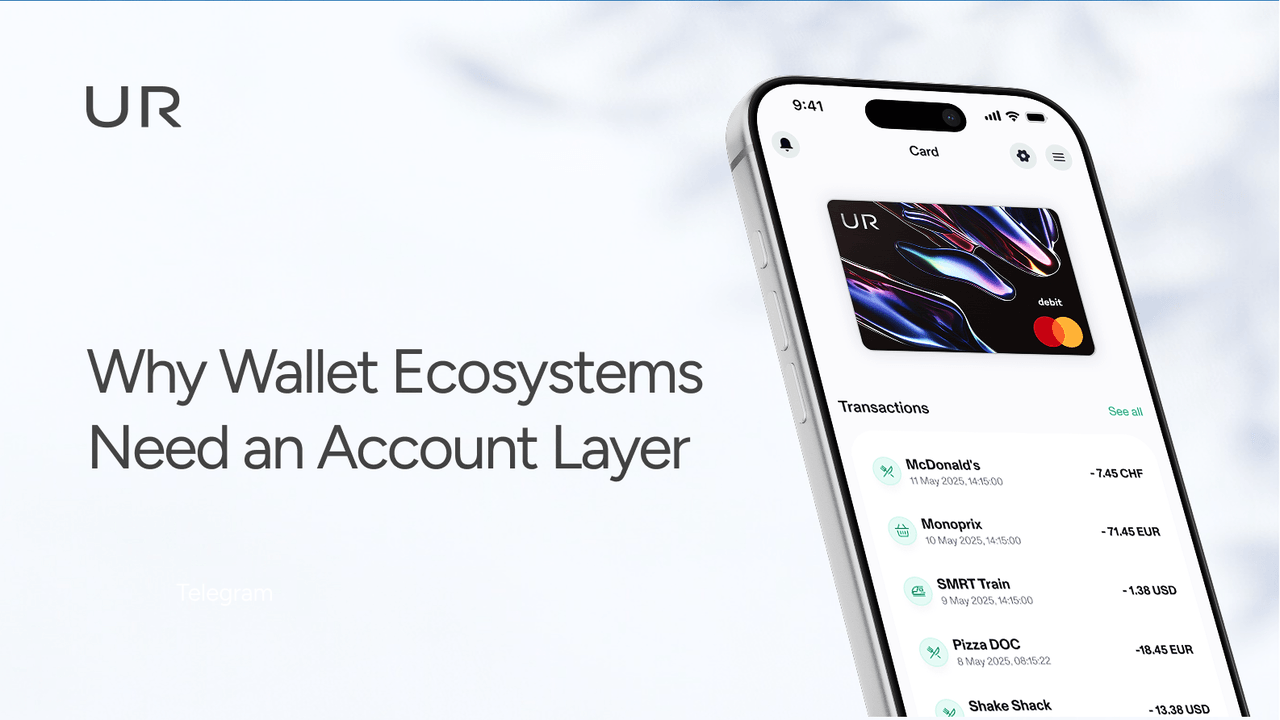
UR is not a bank; it is the financial infrastructure for the open economy, letting platforms manage and move stablecoins and fiat from a single account. Its platform product, UR Platform, is the account layer described in this guide: real, individual accounts with a Swiss IBAN, 7 fiat currencies (EUR, USD, CHF, CNH, SGD, JPY, HKD) alongside 20+ digital assets, SEPA instant and SWIFT, co-branded virtual Mastercards, On-/Off-Ramps with 0% Off-Ramp fees, and fully audited KYC/AML built in — through one API.
Integration supports two models, chosen by the end-user experience the platform wants rather than by what kind of platform it is. In the user-controlled model, fiat balance, FX, pay-in and payout actions can only be triggered by the user's own self-custodial wallet keys; UR never holds or manages users' digital assets. In the platform-managed model, the platform operates the account entirely via API. KYC is modular in either mode: platforms can use UR's hosted verification flow, run verification inside their own UI, or share existing verification data — and UR performs its own verification and screening in every case. The implementation follows the same steps: display the KYC flow, show the cash account module after verification, listen to webhooks for status and transaction updates, and optionally issue the co-branded Mastercard. Integration goes live in weeks.
The infrastructure already runs at scale: 240,000+ accounts, over $1.2B in tokenized deposits, and live partners including SafePal, Bitget Wallet, imToken and TopNod. The honest trade-off: UR is infrastructure, not a consumer app — the platform owns the user relationship and product experience, and market coverage depends on UR's licensing footprint rather than the platform's ambitions.
FAQs
What is the difference between an account layer and a payment integration?
A payment integration typically adds one rail — usually card acceptance. An account layer is the full stack underneath an account: a personal IBAN, multi-currency fiat balances, instant conversion between fiat and digital dollars, and built-in compliance that links the wallet and the IBAN to one verified user. One adds a feature. The other gives you an account.
Do I need a license to offer accounts to my users?
In most jurisdictions, yes — holding client fiat and operating payment rails requires an e-money license or a payment institution license. The alternative is partnering with a licensed provider: the regulated activity sits under their license and your platform integrates via API. Specific arrangements vary; talk to qualified legal counsel before launching.
Who is responsible for compliance when using an account layer provider?
Responsibility is shared. The provider handles the infrastructure — KYC, AML screening, travel-rule controls, and ongoing transaction monitoring. The platform handles its own product design and the users it onboards, making sure neither circumvents those controls. The specific allocation is governed by the partnership agreement and the regulatory framework of each target market.
How long does it take to integrate an account layer?
Weeks, not months. The integration flow is designed to be implementable by a small engineering team using the documented API endpoints and schemas. This compares to 12 to 24 months for equivalent infrastructure built in-house, including the time required to obtain necessary licenses and establish partner relationships.
Can I offer accounts to users in multiple countries?
Yes, subject to the provider's licensing footprint and each market’s local rules. UR's infrastructure itself supports users in 40+ countries around the world. Platforms targeting multiple geographies should evaluate providers on regulatory coverage and confirm which markets are supported under the provider's existing licenses before committing to regional expansion plans.